Sunday, August 19, 2018

Amartya Sen on Capabilities and Functionings

Citation: Thomas Wells, The Internet Encyclopedia of Philosophy, ISSN 2161-0002, https://www.iep.utm.edu/, 19/08/18.

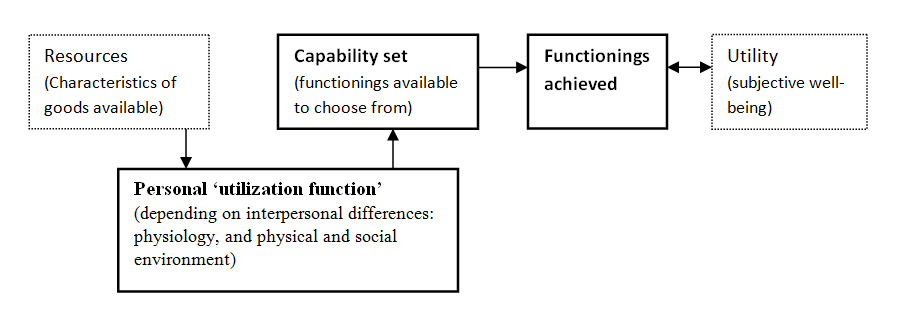
TASK: Identify the 'Resources' that were made available to you and reflect on how it has changed your capabilities.

Functionings and Capability
https://www.iep.utm.edu/wp-content/media/Sen-Chart1.jpg“When evaluating well-being, Sen argues, the most important thing is to consider what people are actually able to be and do. The commodities or wealth people have or their mental reactions (utility) are an inappropriate focus because they provide only limited or indirect information about how well a life is going. Sen illustrates his point with the example of a standard bicycle. This has the characteristics of ‘transportation’ but whether it will actually provide transportation will depend on the characteristics of those who try to use it. It might be considered a generally useful tool for most people to extend their mobility, but it obviously will not do that for a person without legs. Even if that person, by some quirk, finds the bicycle delightful, we should nevertheless be able to note within our evaluative system that she still lacks transportation. Nor does this mental reaction show that the same person would not appreciate transportation if it were really available to her.
The Capability Approach focuses directly on the quality of life that individuals are actually able to achieve. This quality of life is analyzed in terms of the core concepts of ‘functionings’ and ‘capability’.

  • Functionings are states of ‘being and doing’  such as being well-nourished, having shelter. They should be distinguished from the commodities employed to achieve them (as ‘bicycling’ is distinguishable from ‘possessing a bike’).
  • Capability refers to the set of valuable functionings that a person has effective access to. Thus, a person’s capability represents the effective freedom of an individual to choose between different functioning combinations – between different kinds of life – that she has reason to value. (In later work, Sen refers to ‘capabilities’ in the plural (or even ‘freedoms’) instead of a single capability set, and this is also common in the wider capability literature. This allows analysis to focus on sets of functionings related to particular aspects of life, for example, the capabilities of literacy, health, or political freedom.)”


Sunday, February 25, 2018

...Some Understanding About LoUs (From RBI Website)

Available at: https://rbi.org.in/scripts/NotificationUser.aspx?Mode=0&Id=10201

RBI, Master Direction 17 – Import of Goods and Services

Issue of Guarantees by an Authorised Dealer
B.8.1 An authorised dealer may give a guarantee in respect of any debt, obligation or other liability incurred by a person resident in India and owned to a person resident outside India, as an importer, in respect of import on deferred payment terms in accordance with the approval by the Reserve Bank of India for import on such terms.

B.8.2 An authorised dealer may give guarantee, Letter of Undertaking of Letter of Comfort in respect of any debt, obligation or other liability incurred by a person resident in India and owned to a person resident outside India (being an overseas supplier of goods, bank or a financial institution), for import of goods, as permitted under the Foreign Trade Policy announced by Government of India from time to time and subject to such terms and conditions as may be specified by Reserve Bank of India from time to time.

B.8.3 An authorised dealer may, in the ordinary course of his business, give a guarantee in favour of a non-resident service provider, on behalf of a resident customer who is a service importer, subject to such terms and conditions as stipulated by Reserve Bank of India from time to time:

Provided that no guarantee for an amount exceeding USD 500,000 or its equivalent shall be issued on behalf of a service importer other than a Public Sector Company or a Department / Undertaking of the Government of India / State Government:

Provided further that where the service importer is a Public Sector Company or a Department / Undertaking of the Government of India / State Government, no guarantee for an amount exceeding USD 100,000 or its equivalent shall be issued without the prior approval of the Ministry of Finance, Government of India.
B.8.4 An authorised dealer may, subject to the directions issued by the Reserve Bank of India in this behalf, permit a person resident in India to issue corporate guarantee in favour of an overseas lessor for financing import through operating lease effected in conformity with the Foreign Trade Policy in force and under the provisions of the Foreign exchange Management (Current Account Transactions) Rules, 2000 framed by the Government of India vide Notification No. G. S. R. 381 (E) dated May 3, 2000 and the Directions issued by Reserve Bank of India under Foreign Exchange Management Act, 1999 from time to time.

Saturday, February 3, 2018

Investment Schemes: How They Have Been Modified Under Budget 2018?

Investment Scheme
Employee’s Contribution
Employer’s Contribution
Lock-in period
Taxability at the stage of withdrawal
ELSS
Deduction under section 80C within the cap of INR 150,000 per year
Not applicable
3 years
1) Long term gains subject to Securities Transaction Tax (‘STT’) – Exempt; 2) Long term gains not subject to STT – Taxable at 20% (plus applicable Surcharge and Education Cess)
Public Provident Fund
15 years
Exempt
Life Insurance Premium
Depends on the tenure of policy
Exempt subject to the provisions of section 10(10D)
NSC
NSC up to VIII Issue – 5 years. NSC IX Issue – 10 years
Interest is taxable
Tax saving fixed deposits
5 years
Interest is taxable
Recognised Provident Fund (RPF)
Exempt under section 10(12) up to contribution of 12% of salary
58 years / early withdrawal (subject to conditions specified)
Exempt under following circumstances:
1) Completion of 5 years of continuous service;
2) Employee’s ill health or by contraction or discontinuance of the employer’s business or other cause beyond the control of the employee;
3) Transfer of accumulated balance to the new RPF at the time of change of employment;
4) Transfer of entire accumulated balance to NPS
National Pension Scheme (NPS)
Deduction under section 80CCD(1B) up to INR 50,000 ; in addition to INR 150,000 under section 80C
Deduction up to 10% of the salary under section 80CCD(2)
60 years / partial withdrawal option available (subject to conditions specified)
At the time of withdrawal upon retirement:
* 60% of accumulated balance can be withdrawn and 40% to be invested in purchase of annuity;
* 40% of accumulated balance is exempt and 20% is taxable.Withdrawal before retirement:
* 20% of accumulated balance can be withdrawn, which is fully exempt;
* 80% of accumulated balance to be invested in purchase of annuity.
Approved Superannuation
Deduction under section 80C within the cap of INR 150,000 per year
Taxable as a perquisite if the same is in excess of INR 100,000 per year under section 17(2)(vii) Maximum contribution including Provident Fund cannot exceed 27% of salary as per Rule 87

Retirement: Exemption subject to the provisions of section 10(13) Resignation: Fully Taxable

Sunday, January 28, 2018

What Are Derivatives?


A derivative is a financial contract that derives its value from an underlying asset. The buyer agrees to purchase the asset on a specific date at a specific price.

Derivatives are often used for commodities, such as oil, gasoline or gold. Another asset class is currencies, often the U.S. dollar. There are derivatives based on stocks or bonds. Still others use interest rates, such as the yield on the 10-year Treasury note.

The contract's seller doesn't have to own the underlying asset. He can fulfill the contract by giving the buyer enough money to buy the asset at the prevailing price. He can also give the buyer another derivative contract that offsets the value of the first. This makes derivatives much easier to trade than the asset itself.

Derivatives Trading
In 2016, 25 billion derivative contracts were traded.  Asia commanded 36 percent of the volume, while North America traded 34 percent. Twenty percent of the contracts were traded in Europe. These contract were worth $570 trillion in 2016. That's six times more than the economic output of the world.

More than 90 percent of the world's 500 largest companies use derivatives to lower risk. For example, a futures contract promises delivery of raw materials at an agreed-upon price. This way the company is protected if prices rise. Companies also write contracts to protect themselves from changes in exchange rates and interest rates.

Derivatives make future cashflows more predictable. They allow companies to forecast their earnings more accurately. That predictability boosts stock prices. Businesses then need less cash on hand to cover emergencies. They can reinvest more into their business.

Most derivatives trading is done by hedge funds and other investors to gain more leverage.


That’s because derivatives only require a small down payment, called “paying on margin.” Many derivatives contracts are offset, or liquidated, by another derivative before coming to term. That means these traders don't worry about having enough money to pay off the derivative if the market goes against them. If they win, they cash in.

What are Derivative Instruments?
A derivative is an instrument whose value is derived from the value of one or more underlying, which can be commodities, precious metals, currency, bonds, stocks, stocks indices, etc. Four most common examples of derivative instruments are Forwards, Futures, Options and Swaps. 


What are Forward Contracts? 

A forward contract is a customized contract between two parties, where settlement takes place on a specific date in future at a price agreed today. The main features of forward contracts are 

1.      They are bilateral contracts and hence exposed to counter-party risk.
2.      Each contract is custom designed, and hence is unique in terms of contract size, expiration date and the asset type and quality.
3.      The contract price is generally not available in public domain.
4.      The contract has to be settled by delivery of the asset on expiration date.
5.      In case the party wishes to reverse the contract, it has to compulsorily go to the same counter party, which being in a monopoly situation can command the price it wants.


What are Futures?

Futures are exchange-traded contracts to sell or buy financial instruments or physical commodities for a future delivery at an agreed price. There is an agreement to buy or sell a specified quantity of financial instrument commodity in a designated future month at a price agreed upon by the buyer and seller.To make trading possible, BSE specifies certain standardized features of the contract. 


What is the difference between Forward Contracts and Futures Contracts? 

Sr.No
Basis
Futures
Forwards
1
Nature
Traded on organized exchange
Over the Counter
2
Contract Terms
Standardized
Customised
3
Liquidity
More liquid
Less liquid
4
Margin Payments
Requires margin payments
Not required
5
Settlement
Follows daily settlement
At the end of the period.
6
Squaring off
Can be reversed with any member of the Exchange.
Contract can be reversed only with the same counter-party with whom it was entered into.

Thursday, January 18, 2018

National Asset Directory

Though in the nascent stage, the National Asset Directory envisages to capture assets across the country by creating a data base through a mobile app. Great idea to check out State wise, District wise and Village / Town wise data of assets across several categories. Digitization of assets was a need in out country since long.

Visit website: www.assetdirectory.gov.in/

Explore the database and the idea itself and comment on how this is a tool for nation building.

National Asset Directory (NAD) is one of the 12 applications developed as part of Panchayat Enterprise Suite (PES). NAD aims to keep a stock of all the assets created/ controlled/ maintained by the Rural Local Bodies (RLBs) i.e. Panchayats at district, intermediate and village level, Urban Local Bodies (ULBs) i.e. Municipalities, Corporations, Town Areas etc. and Line Departments in the country. It is felt that RLBs/ULBs/Line Departments are creating a large number of assets under various schemes. However, due to lack of information, sometimes new assets are being created when the requirement could be met by repairing/upgrading old ones leading to a sub-optimal utilization of scarce funds and resources. NAD envisages facilitating proper planning, convergence of funds from various schemes and record keeping of various assets created/maintained/controlled by RLBs/ULBs/Line Departments. It acts as a repository of various assets created/ controlled/ maintained by RLBs/ULBs/Line Departments and assigns a code to each asset for its unique identification leading to effective utilization of the assets. 

NAD is web-based application software that envisages facilitating proper planning, convergence of funds from various schemes and record keeping of various assets created/maintained/controlled by RLBs/ULBs/Line Departments by assigning a unique ID to each asset. 

NAD captures all details related to an asset as it goes through various stages of its life cycle viz. asset creation through construction, acquisition, purchase etc. asset upgradation, asset maintenance, asset earnings and disposal. The key features of this software include: Generates a unique Asset ID: NAD generates a unique Asset ID for identification of Assets created/maintained/controlled RLB/ ULB/ Line Department. Captures Asset Details: NAD captures all details related to an asset as it goes through its life cycle including General details such as Asset type, category & sub category of asset, order number, order date, order issuing authority, parameter(s) of asset (s), Source of funds, location of asset, purpose of asset creation, cost of asset, expected life of asset, way by which asset is created (constructed, purchased, donated, acquired), supporting document (s), etc. and the specific details viz. Name of Asset, Asset description, Operationalization Date and Geo Reference Location for individual asset. Location of asset can be physical location e.g. village in case of immovable assets such as building, land etc. or Panchayat offices in case of movable assets say generator located in RLB.  

Sunday, September 24, 2017

Asymmetric Information & Its Impact on Market Participants


"Asymmetric information, sometimes referred to as information failure, is present whenever one party to an economic transaction possesses greater material knowledge than the other party. This normally manifests itself when the seller of a good or service has greater knowledge than the buyer, although the opposite is possible. Almost all economic transactions involve information asymmetries.

Asymmetric information is the specialization and division of knowledge in society as applied to economic trade. For example, medical doctors tend to know more about medical treatment than their patients; after all, those doctors specialize in medicine, while their patients do not. The same principle applies to manufacturers, teachers, police officers, attorneys, restaurant operators and yoga instructors, or any other specialized profession.

Economic Advantages
Growing asymmetrical information is a desirable outcome of a market economy. As workers specialize and become more productive in their fields of expertise, they can provide greater levels of value to workers in other fields. For example, a stockbroker’s services are less valuable to customers who already know enough to buy and sell their own stocks with confidence.
One alternative to ever-expanding asymmetric information is for workers to study in all fields, rather than specializing in those fields where they can provide the most value. This comes with large opportunity costs and would likely result in a lower level of aggregate output, lowering standards of living.
Another alternative is to make information abundantly and cheaply available, such as through the internet. This does not replace asymmetric information, however. It only has the effect of moving information asymmetries away from simpler areas and into more complex areas.

Possible Problems
In certain circumstances, asymmetric information may lead to adverse selection or moral hazard. These are situations where individual economic decisions are hypothetically worse than they would have been had all parties possessed more symmetrical information. Most of the time, the solutions to adverse selection and moral hazard are not complicated.

Consider adverse selection in life insurance or fire insurance. Higher-risk insurance customers, such as smokers, the elderly or those living in dry environments, may be more likely to purchase insurance. This could raise insurance premiums for all customers, forcing the healthiest to drop out. The solution is to perform actuarial work and insurance screening, then charge different premiums to different customers based on potential risk."
Source: Article 'Asymmetric Information' published on Investopedia

“Following the seminal work of Stiglitz and Weiss (1981), a large theoretical literature has stressed the key role of asymmetric information in lending markets. A majority of studies shows that asymmetric information can generate market failures such as credit rationing, inefficient provision, mispricing of risk, and, in the limit, market breakdown. Moreover, a financial crisis can exacerbate the negative effects of adverse selection and moral hazard in financial markets (Mishkin 2012). Deepening our understanding of the extent and effects of asymmetric information is key for the design of a regulatory framework that limits their negative consequences. The theory has analysed the effects of asymmetric information mostly under the assumption of a perfectly competitive credit market, an assumption that is not likely to hold in many relevant markets. Correspondingly, there is no clear evidence of the effects of the interaction of asymmetric information and imperfect competition in lending markets.” As stated in article titled ‘Asymmetric information and imperfect competition in lending markets’ on Voxeu.org